Why Salvia divinorum almost never makes seed
It flowers. It makes pollen. A hummingbird has even been seen working its flowers. Then, somewhere inside the flower, the process stops.
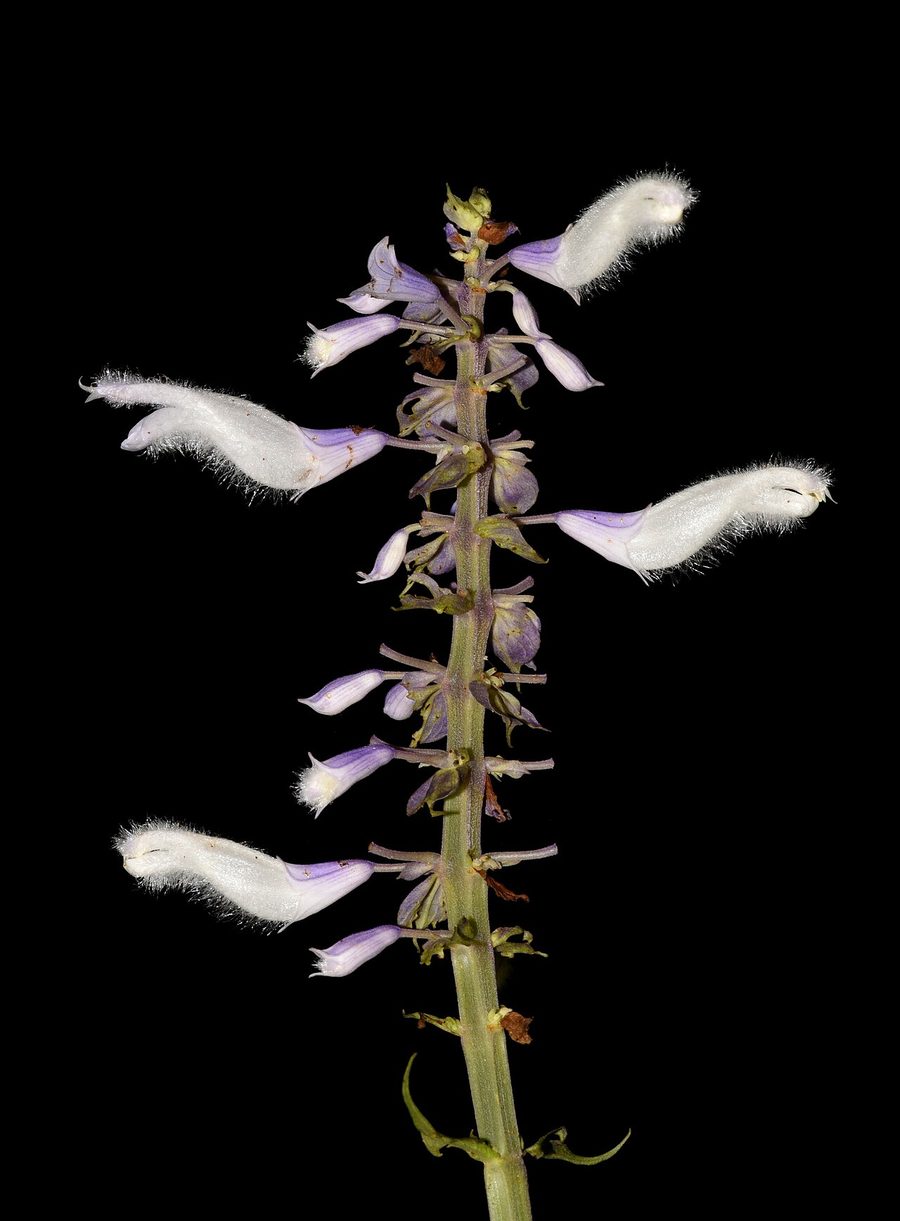
Almost every Salvia divinorum plant alive today started as a cutting from another plant. That is not a choice growers made. It is because the species almost never produces seed, even though it flowers. Botanists have spent decades working out where the process breaks down. This note walks through what they found.
- In the wild
- No seed has been found on field plants (Reisfield, 1993, p. 356).
- Pollen
- About 56% of pollen grains were aborted in greenhouse plants, and 53% in wild material (Reisfield, 1993, p. 361).
- By hand
- Only about 3% of possible seeds matured after cross-pollination, and about 2.5% after self-pollination (Reisfield, 1993, p. 361).
- Where it fails
- After the pollen reaches the ovary. The young seed most likely fails to develop (Reisfield, 1993, pp. 362–363).
- Why it matters
- Nearly every plant is a clone, so named lines and their history carry real weight.
It does flower
In its home range it flowers sporadically from about September to May (Reisfield, 1993, p. 363). Flowering is promoted by sunlight: flowering stems were most common where plants stood in full or partial sun (Reisfield, 1993, pp. 355, 357).
Day length is the trigger. The plant "depends on a shorter photoperiod to produce flowers" (Hanna, 1999). To get greenhouse plants to bloom, Reisfield covered them with black cloth each afternoon, giving them 8–10-hour days. Buds appeared about two months later, and flowers opened about a month after that (Reisfield, 1993, pp. 353, 358).
The flower is built for a bird
The corolla is a narrow, S-curved tube 19–22 mm long with a cupped lower lip, a shape Reisfield notes is uncommon in bee flowers and typical of hummingbird-pollinated sages (Reisfield, 1993, pp. 358–359). Greenhouse flowers held about 8–16 µl of nectar, at 21–23% sugar, which also fits bird flowers better than bee flowers (Reisfield, 1993, p. 360).
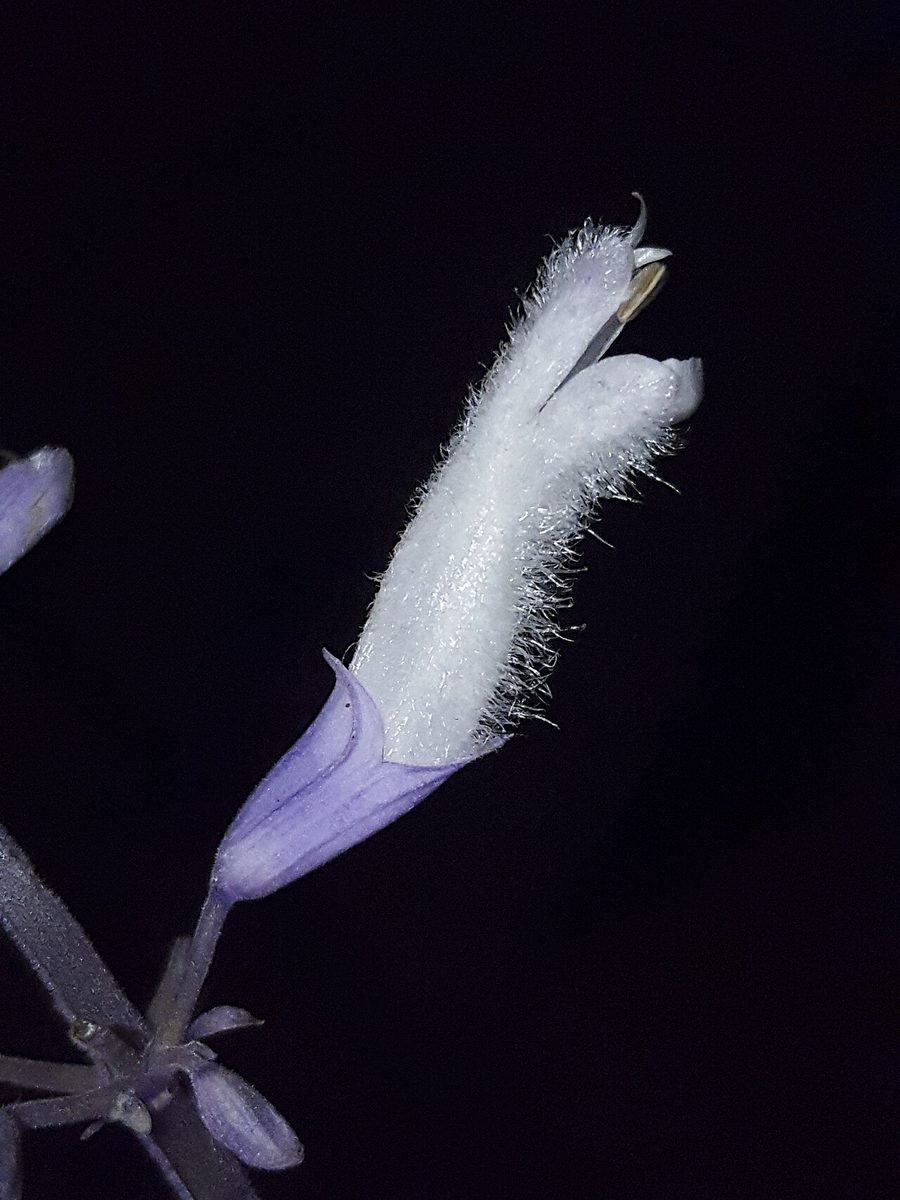

Only one pollinator visit has been described. During an overnight watch at a flowering stand, "at the first signs of dawn, under an overcast sky," a single large hummingbird with a strongly curved bill visited virtually every flower, drank most of the nectar, and left pollen on several stigmas (Reisfield, 1993, p. 360). Reisfield is careful about what it means: one visit "can in no way be considered evidence for the coevolution" of the plant and that bird, and the white corolla does not fit the usual hummingbird pattern (Reisfield, 1993, pp. 360–361).
About half the pollen is dead
Reisfield stained pollen to tell living grains from aborted ones. In greenhouse plants, 882 of 1,587 grains were aborted, about 56%. In material from a stand at Cerro Quemado, 1,592 of 3,027 were aborted, about 53%. Three other sages, tested the same way, had virtually all of their pollen stain as living (Reisfield, 1993, p. 361).
Pollination works. The seed does not.
Each flower can make up to four small seeds, called nutlets. That makes the hand-pollination results easy to read (Reisfield, 1993, pp. 352, 361):
| Trial | Flowers | Mature seeds | Of possible seeds |
|---|---|---|---|
| Valdés, cross-pollination | 14 | 8, from 4 flowers (Hanna, 1999) | about 14% |
| Reisfield, self-pollination | 108 | 11 | about 2.5% of 432 |
| Reisfield, cross-pollination | 190 | 24 | about 3% of 760 |
The pollen is not being blocked. When Reisfield examined pollinated styles, 13 of 39 had four or more pollen tubes reaching the ovary, with no sign of the tubes being stopped (Reisfield, 1993, p. 362). The barrier comes after that. His conclusion: "post-zygotic embryo abortion or endosperm failure is probable" (Reisfield, 1993, p. 363). In plain terms, fertilization appears to happen, and then the young seed fails to develop. Most flowers dropped their calyces 5–10 days after pollination (Reisfield, 1993, p. 361).
Why? Three ideas
- A hybrid origin. Reisfield suggested the plant's problems might be best explained by hybridity, though no parent species had been identified (Reisfield, 1993, p. 363). A DNA study later found that Salvia divinorum "does not appear to be an interspecific hybrid" and placed its closest relative in Colombia, Salvia venulosa (Jenks et al., 2011).
- Inbreeding, through cloning. Many separate stands appear to come from a single source, so a "cross" between two stands may really be a plant pollinating itself (Reisfield, 1993, p. 362). Reisfield adds that inbreeding depression "is often the fate of taxa that become closely associated with man" (Reisfield, 1993, pp. 362–363).
- A missing partner. The flower is shaped for birds, but no regular pollinator has been confirmed in its current range (Reisfield, 1993, pp. 360–361).
The DNA study's authors describe it as "a reproductively capable species" (Jenks et al., 2011). The question is still open.
The few times it has set seed
Seed is rare, not impossible, and the seeds that do form can grow. Reisfield germinated some of his, and the seedlings grew into vigorous plants indistinguishable from their parents (Reisfield, 1993, p. 361).
- Hawaii, 1994. Daniel Siebert collected 70 seeds from plants at a botanical garden in Hawaii, with no hand-pollination. Twelve or thirteen germinated, and six survived (Hanna, 1999).
- Hawaii, 1999. A commercial grower in Hawaii with about 800 plants under 70% shade cloth collected 305 seeds and did not think his hand-pollination caused them. Of 100 sown, 31 germinated and 10 survived (Hanna, 1999).
- United Kingdom, 2021. A nursery in the UK reported hand-pollinating more than 6,000 flowers across many plants to get 108 seeds. Of the 91 it sowed, 27 germinated, and 12 grew into healthy seedlings; the rest were stunted or deformed (Enchanted Plants Nursery, self-reported). It dates its first viable seed to 2021 (Enchanted Plants Nursery, clone list). These numbers come from the grower's own accounts, not a published study.
Every seedling is a new individual, genetically distinct from its parent, although the seed-grown plants described so far look almost identical to their parents. The one exception noted was one of Siebert's seedlings, the clone known as Paradox, with leaves that are "ever so slightly mottled" (Hanna, 1999).
What it means
Because seed is so rare, the plant has been passed from person to person as cuttings for generations. A named clone is one individual plant, kept going for decades. That is why the name and history of a clone are worth knowing, and why the handful of plants raised from seed stand out.
Sources
- Reisfield, A. S. (1993). The botany of Salvia divinorum (Labiatae). SIDA, 15(3), 349–366. PDF
- Jenks, A. A., Walker, J. B., & Kim, S.-C. (2011). Evolution and origins of the Mazatec hallucinogenic sage, Salvia divinorum (Lamiaceae): a molecular phylogenetic approach. Journal of Plant Research, 124, 593–600. PDF
- Hanna, J. (1999). Growing Salvia divinorum from seed. The Entheogen Review, 8(3), 110–112. PDF
- Enchanted Plants Nursery. Salvia divinorum seed project (grower's own account). Web page
- Enchanted Plants Nursery. Different Salvia divinorum clones (grower's own account). Web page
We sell live plants for growing, to adults, and ship only to states where the plant is legal. Page numbers refer to the published articles. Photos are credited where they appear.