Where Salvia divinorum grows
Shaded, foggy ravines in one mountain range in Oaxaca. What the botanical record says about that place, and what it means for keeping the plant in a home.
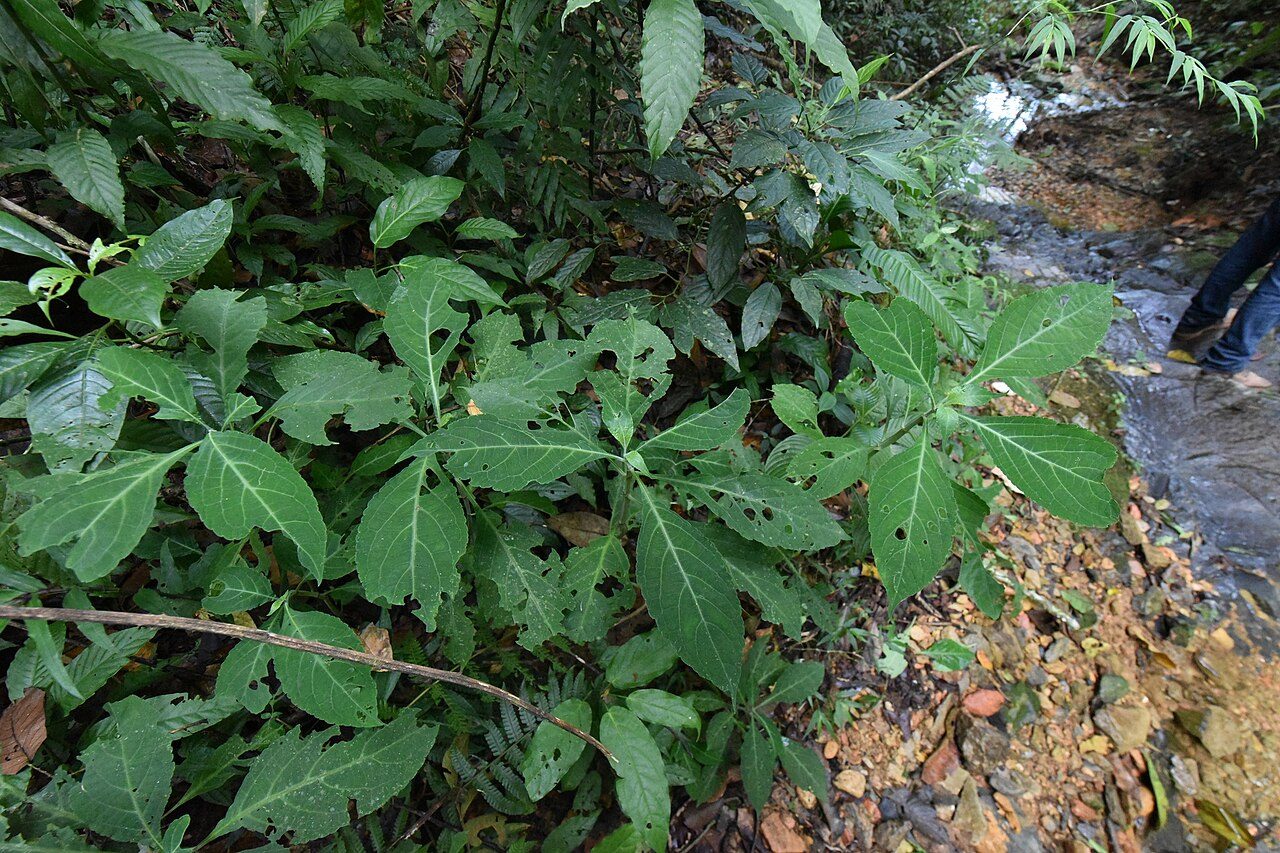
Most care advice for this plant is passed from grower to grower, the same way the plant itself is. We wanted to check that advice against the source: the botanists who went to the Sierra Mazateca and wrote down where the plant actually grows. This note collects what they found and sets it next to what published care guides say.
- Where
- The Sierra Mazateca, northern Oaxaca, Mexico, at about 300–1,800 m (Reisfield, 1993, p. 364).
- Climate
- Mild and very wet: annual averages around 61–68°F in the highland towns, 2.5–4+ m of rain a year, often in fog (Reisfield, 1993, pp. 351–358).
- Ground
- Shaded ravines and stream banks with black soil and deep leaf litter (Epling & Játiva-M., 1962; Reisfield, 1993, p. 356).
- Light
- Shade. Unlike most sages, it does best in dark, humid spots (Reisfield, 1993, p. 357).
- For growers
- Keep it mild, moist and shaded. It can be adjusted to drier room air if you go slowly (Beifuss, 1997).
One mountain range, a few square miles
Science first described the plant in 1962, from specimens collected near San José Tenango "in ravines with black soil marginal to the wet forest" (Epling & Játiva-M., 1962). Later fieldwork found it in the same small area: in the winter of 1984–85, the botanist A. S. Reisfield located about 15 populations (Reisfield, 1993, p. 355), all within a few square miles of each other (Jenks et al., 2011).
Reisfield recorded the species between 300 and 1,800 m (Reisfield, 1993, p. 364). An earlier ethnobotanical study gives 750–1,500 m (Valdés et al., 1983). For scale, the town of Huautla de Jiménez sits at about 1,700 m and Ayautla at 733 m (Reisfield, 1993, p. 351).
None of these stands has been confirmed as wild. The populations Reisfield found were clonal and showed signs of people: stems cut for their leaves, and stands on coffee hillsides where the plant was "almost certainly introduced" (Reisfield, 1993, pp. 355–358). He describes its distribution as anthropogenic, shaped by people, and notes that the Mazatec propagate it by pushing cut branches into the soil (Reisfield, 1993, pp. 349, 357–358).
Mild, very wet, and often in fog
Reisfield gives annual average temperatures of about 61°F at Huautla and about 68°F at Ayautla, with warmer areas near Ixcatlán above 78°F (Reisfield, 1993, pp. 351–352). Mexico's statistics agency reports mean annual temperatures of 16–24°C (about 61–75°F) across the municipality of Huautla de Jiménez (INEGI, 2010).
Rain is the other defining number. Reisfield reports 256 cm to over 400 cm a year in the highlands, roughly 100 to 160 inches, and one ravine with a population averaged 472 cm, about 186 inches (Reisfield, 1993, pp. 351, 356). The national figures for the municipality run from 2,000 to 5,000 mm (INEGI, 2010). Some of the sites are "regularly blanketed in fog," and stands on coffee hillsides are "continuously bathed in fog" (Reisfield, 1993, pp. 356, 358).
Shade, water and black soil
The ground is consistently described the same way. The type specimens came from ravines with black soil at the edge of wet forest (Epling & Játiva-M., 1962). Reisfield describes "a very wet, somewhat disturbed, shaded ravine" at the edge of a coffee plantation, rocky stream banks with some stems in or near the water, and "a thick litter composed of older decaying stems" underfoot (Reisfield, 1993, pp. 355–356). The ethnobotanical study adds that the plant is found "only in forest ravines and other moist humid areas" of the range (Valdés et al., 1983).
The surrounding forest is cloud forest and tropical evergreen forest. The coffee plantation near Huautla "apparently replaced a cloud forest," and the plants grow among aroids, epiphytic ferns and orchids (Reisfield, 1993, pp. 355–356). Its closest known relative, Salvia venulosa, lives in the same kind of place: deeply shaded, moist ravines in the Colombian Andes at 1,500–2,000 m (Jenks et al., 2011).
A sage that hides from the sun
Most sages are sun plants. A typical nursery care sheet for the genus recommends "full sun; a southern exposure" (Logee's). This one is the exception: Reisfield found it colonizing "sites that are dark and humid" most aggressively (Reisfield, 1993, p. 357).
There is one twist. In the field, flowers appeared "only in patches where sunlight penetrated the canopy" (Reisfield, 1993, p. 356). Shade suits the leaves; some light is what triggers blooms. That matters later, for anyone hoping to get the plant to flower.

How it grows there
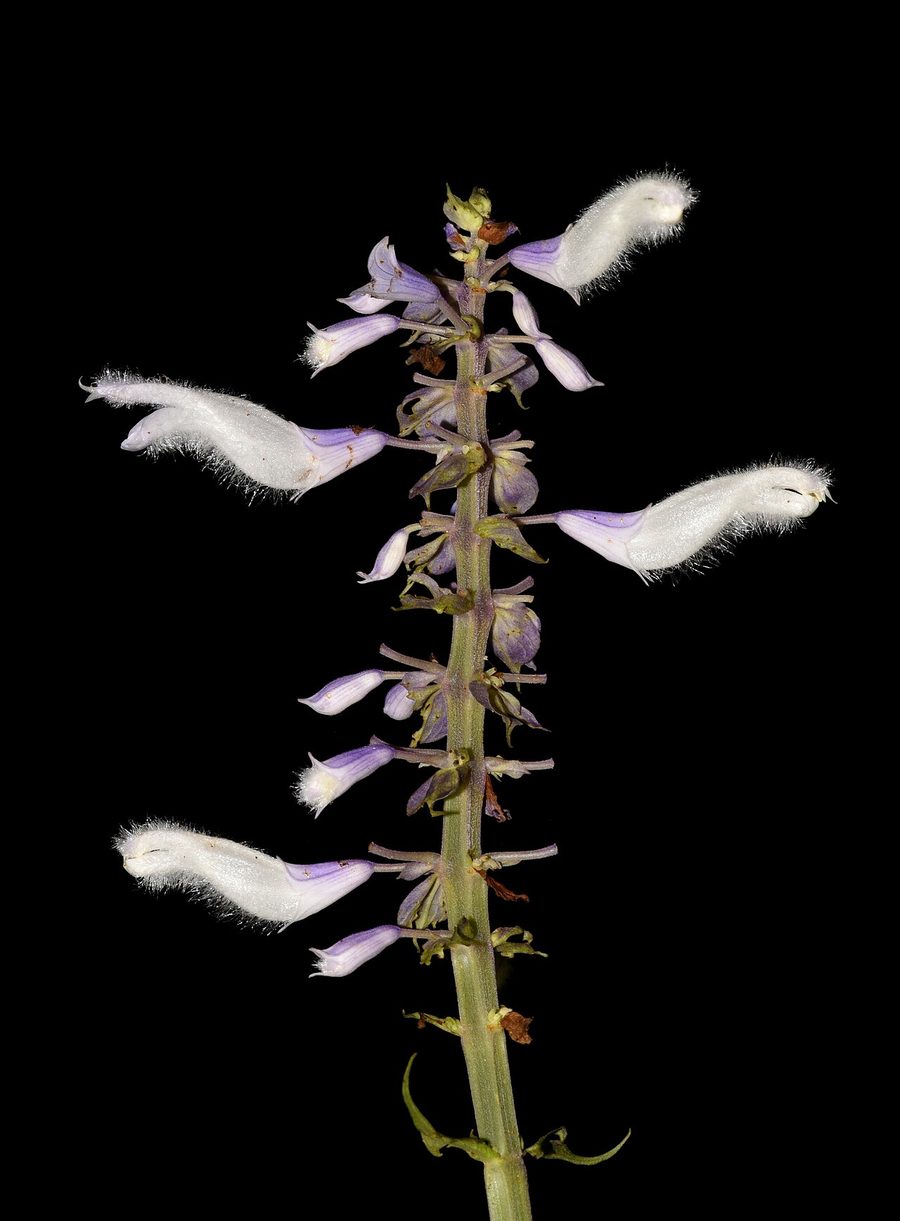
Plants are mostly 0.5–1.5 m tall, with flowering stems reaching 1–2 m and occasionally 3 m (Reisfield, 1993, p. 363). The stems are hollow, fleshy and crisp. Taller ones lie down for part of their length and root "copiously at the nodes" where they touch the ground (Reisfield, 1993, p. 363). That is how a stand spreads, and it is why cuttings root so easily: every node is ready to make roots.
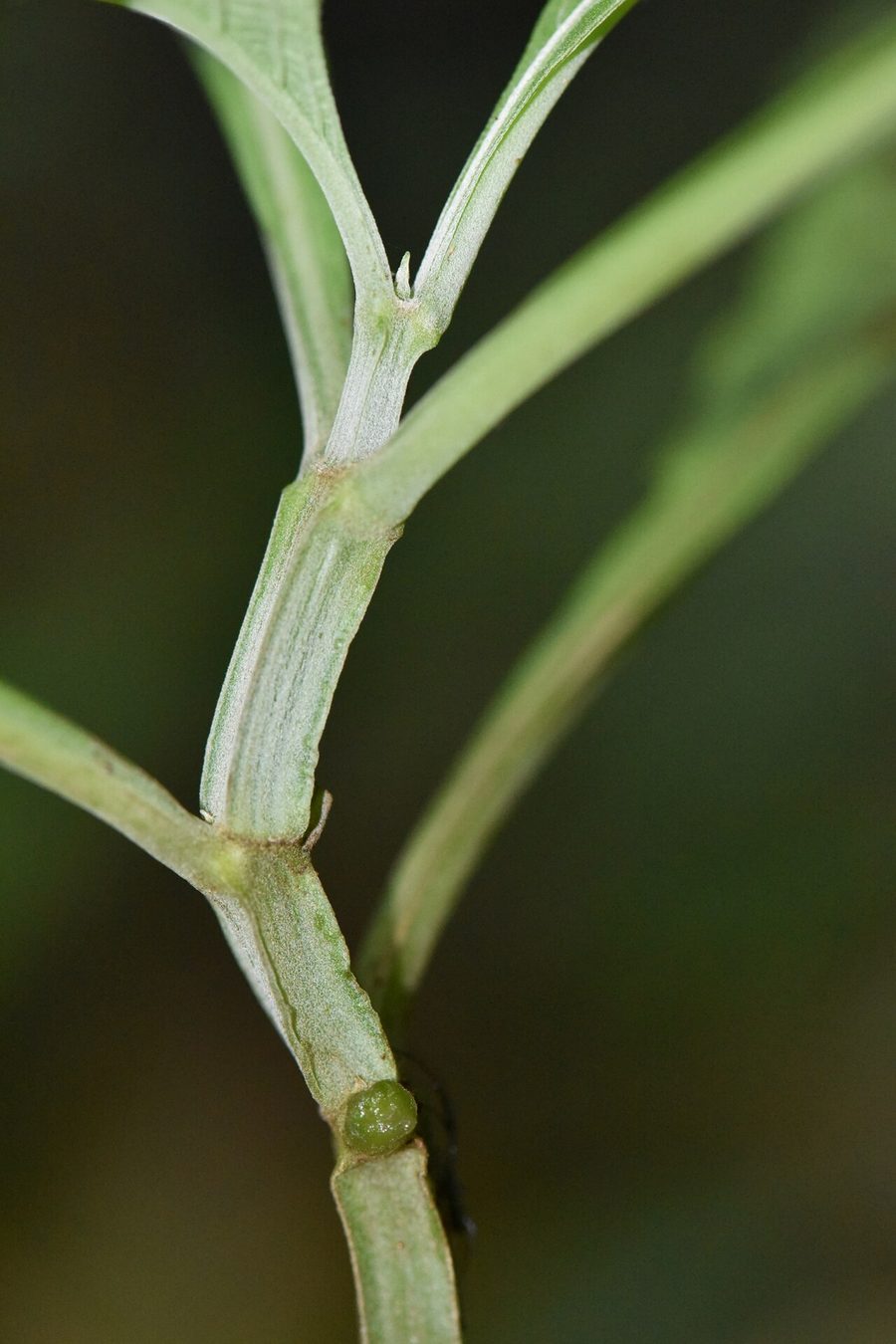

It almost never spreads by seed. No fruit was found on field plants, and hand cross-pollination in the greenhouse gave only about 3% seed set: 24 mature seeds (Reisfield, 1993, pp. 356, 361). About 56% of its pollen is aborted or inviable (Jenks et al., 2011).
What growers recommend, checked against the ravine
Here is how published care sources line up with the habitat record.
| Factor | In the wild | Published guides |
|---|---|---|
| Temperature | Annual averages about 61–68°F in the highland towns, warmer valleys above 78°F (Reisfield, 1993) | Ideal 60–70°F; survived 35°F nights and 100°F spells; frost kills (Beifuss, 1997) |
| Humidity | 2.5 to over 4 m of rain a year; frequent fog (Reisfield, 1993) | Grows best in high humidity, but can be acclimated to lower humidity over several weeks (Beifuss, 1997). A clear bag with a small opening raises humidity (Richters Herbs) |
| Light | Shaded ravines; flowers only where sun breaks through (Reisfield, 1993) | Filtered sunlight; 60% shade cloth outdoors (Beifuss, 1997). Bright light, out of direct sun (Richters Herbs) |
| Water | Very wet ravines; stream banks, some stems in water (Reisfield, 1993) | Plenty of water (Beifuss, 1997). Soft water, rainwater ideal (Richters Herbs) |
| Soil | Black soil and thick litter of decaying stems (Epling & Játiva-M., 1962; Reisfield, 1993) | Friable soil rich in humus, with good drainage; avoid clay (Beifuss, 1997) |
| Feeding | Not studied | Only very dilute fertilizer (Richters Herbs) |
The guides mostly agree with the habitat. The one place they go further is humidity: the ravine is wet all year, but growers report the plant can be weaned onto drier air if it happens slowly (Beifuss, 1997). That is the step we take before any plant leaves us.
What we take from it
- Keep it mild. The 60s and low 70s °F suit it, and it never sees frost at home.
- Keep the air moist, or change it slowly. Fog and rain are its normal; drier rooms are fine after a gradual adjustment.
- Give it shade, not sun. Bright, filtered light, out of direct sun.
- Keep the roots moist, not waterlogged. Our reading of a stream bank: wet, but the water moves. In a pot, that means airy, well-drained mix and watering by feel, not by the calendar.
- Expect it to sprawl and root. Leaning stems and roots at the nodes are how it lives, and why it is easy to propagate.
Sources
- Epling, C., & Játiva-M., C. D. (1962). A new species of Salvia from Mexico. Botanical Museum Leaflets, Harvard University, 20, 75. Transcription
- Reisfield, A. S. (1993). The botany of Salvia divinorum (Labiatae). SIDA, 15(3), 349–366. PDF
- Valdés, L. J., Díaz, J. L., & Paul, A. G. (1983). Ethnopharmacology of Ska María Pastora (Salvia divinorum, Epling and Játiva-M.). Journal of Ethnopharmacology, 7, 287–312. Transcription
- Jenks, A. A., Walker, J. B., & Kim, S.-C. (2011). Evolution and origins of the Mazatec hallucinogenic sage, Salvia divinorum (Lamiaceae): a molecular phylogenetic approach. Journal of Plant Research, 124, 593–600. PDF
- INEGI. (2010). Compendio de información geográfica municipal 2010: Huautla de Jiménez, Oaxaca. PDF
- Beifuss, W. (1997). Cultivating diviner's sage. The Resonance Project, 1. Archived copy
- Richters Herbs. Questions and answers: growing diviner's sage. Web page
- Logee's. Salvia cultural information (care sheet for the genus). PDF
We sell live plants for growing, to adults, and ship only to states where the plant is legal. Page numbers refer to the published articles. Photos are credited where they appear.